Union Ministry of Health and Family Welfare Proposes Amendments to Medical Devices Rules, 2017 to Streamline Licensing Process
New · District CollectorCan you hold the district for 72 hours?Floods, a heatwave, an outbreak, a grievance queue. Take the decisions, see the consequences.Play →In this note
UPSC Prelims + Mains Study Note
1. At a Glance
- Medical Devices Rules (MDR), 2017 is India's dedicated regulatory framework for medical devices, enacted under the Drugs and Cosmetics Act, 1940, replacing earlier piecemeal provisions under Schedule M-III. [1]
- The Ministry of Health and Family Welfare (MoHFW) has, as of 28 June 2026, published a draft notification in the Official Gazette proposing amendments to rationalise manufacturing licence timelines across risk categories — a direct ease-of-doing-business reform. [2]
- UPSC relevance: intersects GS-II (governance/regulatory reform), GS-III (industrial policy, health sector), and India's ambition to become a global medical devices manufacturing hub.
- The reform is aligned with the National Medical Devices Policy and PLI Scheme for Medical Devices, making cross-linkages across multiple Mains topics. [3]
2. Why in the News
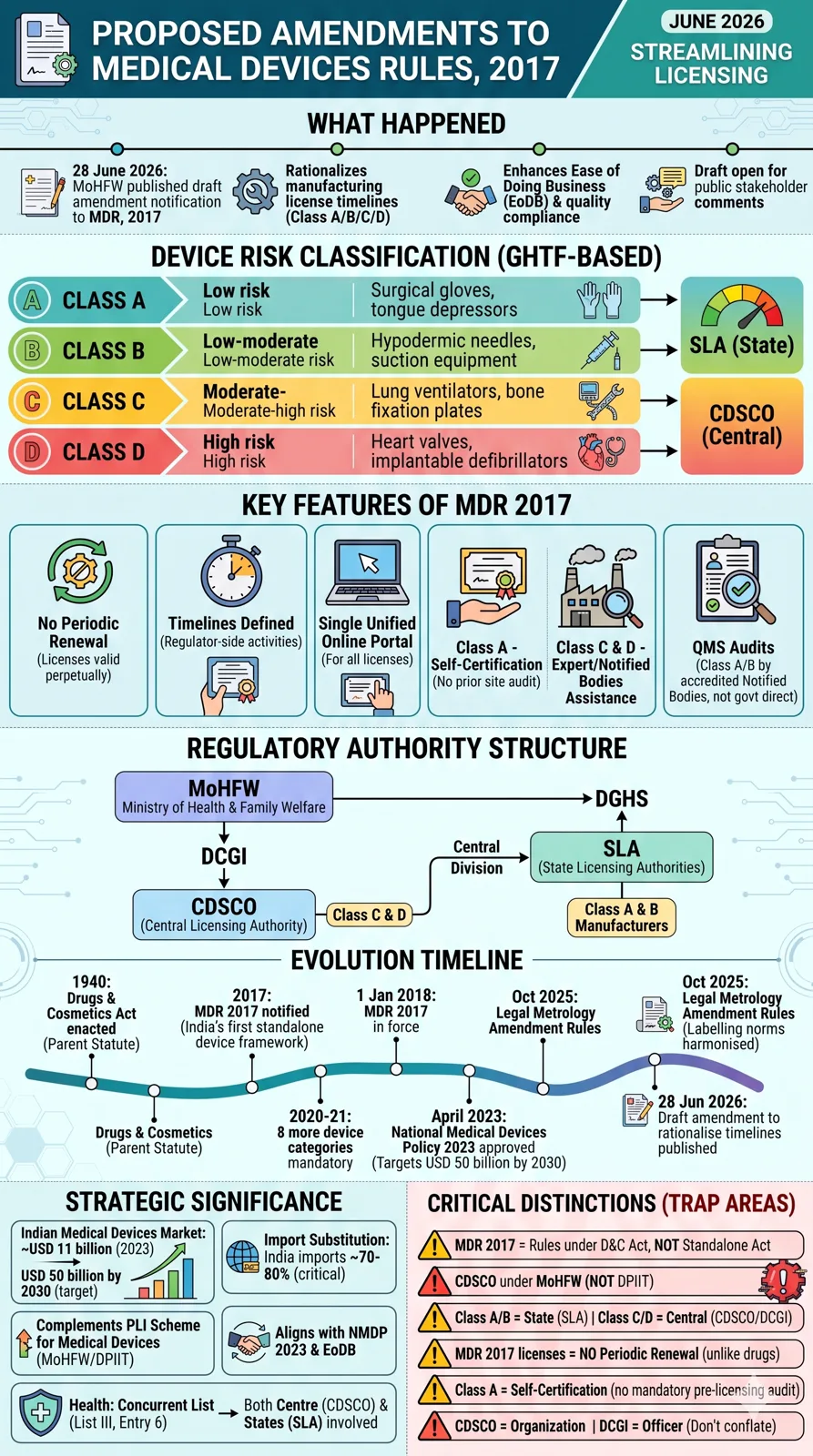
- On 28 June 2026, MoHFW published a draft amendment notification to MDR 2017 in the Official Gazette, specifically targeting: [2]
- Reduction in timelines for grant of manufacturing licences across device risk categories.
- Enhancement of ease of doing business and regulatory efficiency.
-
Ensuring continued compliance with quality, safety and performance standards.
-
The draft is open for public stakeholder comments before finalisation — standard legislative process under the Drugs and Cosmetics Act. [2]
3. Background & Evolution
| Year | Milestone |
|---|---|
| 1940 | Drugs and Cosmetics Act enacted; medical devices loosely covered under "drugs" definition. |
| 2017 | Medical Devices Rules, 2017 notified by MoHFW under D&C Act — India's first standalone regulatory framework for medical devices. [1] |
| January 1, 2018 | MDR 2017 came into force. [1] |
| 2020–21 | Progressive expansion: 8 more medical device categories brought under mandatory regulation under D&C Act. [4] |
| April 2023 | National Medical Devices Policy 2023 approved by Union Cabinet — targets India as a global manufacturing hub; ₹50 billion market size target by 2030. [3] |
| October 2025 | Legal Metrology (Packaged Commodities) Amendment Rules 2025 — medical device packages mandated to follow MDR 2017 labelling requirements. [5] |
| June 2026 | Draft notification for amendments to MDR 2017 to rationalise licensing timelines published. [2] |
- Predecessor regime: Before MDR 2017, select medical devices were regulated as drugs under Schedule M-III of D&C Rules, 1945 — highly fragmented and inadequate for the modern industry.
- Global alignment: Classification framework borrowed from GHTF (Global Harmonization Task Force) — now IMDRF — practices. [1]
4. Core Static Facts
Regulatory Authority Structure:
- Central Licensing Authority (CLA): CDSCO (Central Drugs Standard Control Organisation) under DGHS, MoHFW — regulates Class C and Class D devices. [1]
- State Licensing Authorities (SLA): Regulate Class A and Class B device manufacturers, after QMS audit by accredited Notified Body. [1]
Device Risk Classification (GHTF-based): [1]
| Class | Risk Level | Examples |
|---|---|---|
| A | Low risk | Surgical gloves, tongue depressors |
| B | Low-moderate risk | Hypodermic needles, suction equipment |
| C | Moderate-high risk | Lung ventilators, bone fixation plates |
| D | High risk | Heart valves, implantable defibrillators |
Key Regulatory Features of MDR 2017: [1]
- No periodic renewal of licences; valid until suspended, cancelled, or surrendered.
- Timelines defined for most regulator-side activities.
- Single unified online portal for all licences and permissions.
- Class A: Licence granted without prior site audit; based on self-certification of compliance.
- Class C & D: Expert assistance / Notified Bodies may be called upon by CLA.
Enabling Legislation:
- Drugs and Cosmetics Act, 1940 — parent statute.
- Section 3(b) of D&C Act: definition of "drugs" expanded to include medical devices.
- MDR 2017 notified under Rule-making power vested in the Central Government under D&C Act.
Implementing Ministry/Department:
- Ministry of Health and Family Welfare → DGHS → CDSCO.
5. Multi-Dimensional Analysis
Economic
- India's medical devices market estimated at ~USD 11 billion (2023); targeted to reach USD 50 billion by 2030 under National Medical Devices Policy. [3]
- Streamlined licensing timelines directly reduce regulatory compliance costs and time-to-market for manufacturers, improving investment attractiveness.
- India currently imports ~70–80% of medical devices by value — domestic manufacturing push is critical for import substitution and reducing healthcare costs. [4]
- PLI Scheme for Medical Devices (MoHFW/DPIIT) complements MDR reforms by providing financial incentives to domestic manufacturers.
Administrative
- Rationalising timelines across four risk categories is a targeted administrative reform — applying risk-proportionate regulation (lighter touch for Class A/B, stricter for Class C/D). [1]
- Single online portal reduces manual interface, discretion, and delays — core principle of Ease of Doing Business (EoDB). [1]
- Earlier fragmented SLA/CLA coordination was a bottleneck; reform aims at defining time-bound mandates for each licensing stage. [2]
- Aligns with DPIIT's EoDB rankings initiative and Centre's regulatory simplification agenda.
Legal / Constitutional
- Amendments proposed as draft notification under the Drugs and Cosmetics Act, 1940 — mandatory public consultation before finalisation is a statutory requirement. [2]
- Division of licensing between CLA (Centre) and SLA (States) reflects cooperative federalism in health regulation — health is a Concurrent List (List III, Entry 6) subject. [1]
- Quality, safety and performance compliance requirements are retained even as procedural timelines are rationalised — ensuring no dilution of substantive standards. [2]
Scientific / Technological
- Classification aligned with GHTF/IMDRF global framework — facilitates regulatory convergence and reduces re-testing burden for exporters. [1]
- Notified Bodies (accredited third-party auditors) perform QMS (Quality Management System) audits — introduces private-sector technical expertise into the regulatory chain. [1]
- Streamlined licensing incentivises domestic R&D and innovation in medical technology — critical for self-reliance in high-risk device categories (Class C/D).
Ethical / Governance
- Retaining quality, safety and performance compliance requirements while reducing timelines ensures that speed does not compromise patient safety. [2]
- Self-certification for Class A devices is an important governance trade-off: reduces burden but requires robust post-market surveillance (PMS) to backstop compliance.
- Draft notification process with public comments reflects participatory governance; however, capacity of SME manufacturers to engage is a concern.
6. Recent Developments (last 12–18 months)
- October 2025: Legal Metrology (Packaged Commodities) Amendment Rules 2025 notified — medical device packaging to follow MDR 2017 labelling norms (harmonisation of regulatory requirements). [5]
- 2025: Steps to regulate pricing and quality of medical devices taken by MoHFW — stents, knee implants under price control via NPPA. [6]
- 28 June 2026: MoHFW published draft amendment notification to MDR 2017 in Official Gazette — proposes rationalisation of manufacturing licence timelines across Class A/B/C/D categories; public stakeholder comments invited. [2]
7. Prelims Hooks (high-density factual bullets)
- Medical Devices Rules, 2017 enacted under the Drugs and Cosmetics Act, 1940 — not a standalone statute. [1]
- MDR 2017 came into force on January 1, 2018. [1]
- Medical devices are classified into four risk classes: A (low), B (low-moderate), C (moderate-high), D (high) — based on GHTF framework. [1]
- Class A and Class B manufacturing licences are issued by State Licensing Authorities (SLA), not CDSCO. [1]
- Class C and Class D devices are regulated by the Central Licensing Authority (CLA) — i.e., CDSCO. [1]
- Class A devices are licensed on the basis of self-certification — no prior site audit required. [1]
- Under MDR 2017, manufacturing and import licences are valid perpetually (no periodic renewal) unless suspended, cancelled, or surrendered. [1]
- CDSCO = Central Drugs Standard Control Organisation, under DGHS, Ministry of Health and Family Welfare — not under DPIIT. [1]
- The June 2026 draft amendment aims to rationalise timelines for manufacturing licences — it does NOT dilute quality/safety/performance compliance. [2]
- National Medical Devices Policy 2023 targets India's medical devices market at USD 50 billion by 2030. [3]
- Health is a Concurrent List subject (List III, Entry 6) — hence both Centre (CDSCO/CLA) and States (SLA) are involved in device regulation. [1]
- QMS (Quality Management System) audit for Class A/B licences is conducted by accredited Notified Bodies — not directly by government officials. [1]
- The 2026 draft notification was published on 28 June 2026 by Ministry of Health and Family Welfare. [2]
- India imports approximately 70–80% of its medical devices by value — a key driver of domestic manufacturing push. [4]
8. Mains Relevance
GS Paper Mapping:
| Paper | Syllabus Heading |
|---|---|
| GS-II | Government policies and interventions; Statutory, regulatory and quasi-judicial bodies; Federalism (Centre-State in Concurrent List subjects) |
| GS-III | Indian economy — industrial policy; Infrastructure (health sector); Science & Technology in everyday life |
Plausible Mains Question Stems:
-
"Streamlining manufacturing licence timelines for medical devices is necessary but not sufficient to make India a global medical devices hub. Examine." (GS-III, 15 marks)
9. Related Topics to Study Next
| Topic | Connection |
|---|---|
| Drugs and Cosmetics Act, 1940 | Parent statute of MDR 2017; essential for understanding the legal basis of device regulation. |
| CDSCO and DGHS | Key regulatory bodies implementing MDR 2017; frequently confused in MCQs. |
| National Medical Devices Policy 2023 | Strategic policy framework within which MDR amendments sit; Cabinet-approved. |
| PLI Scheme for Medical Devices | Complementary fiscal incentive scheme; jointly administered by MoHFW and DPIIT. |
| National Pharmaceutical Policy / Drug Price Control | NPPA's price control over medical devices (stents, knee implants) — regulatory overlap. |
| Ease of Doing Business (EoDB) Reforms | MDR amendment is one instance of broader regulatory simplification agenda; DPIIT context. |
| GHTF / IMDRF | International regulatory convergence body whose classification framework India adopted — relevant for GS-II international organisations. |
| Product Liability under Consumer Protection Act, 2019 | Post-market patient redressal mechanism for defective medical devices. |
10. Common Errors / Trap Areas
-
CDSCO vs. DCGI confusion: CDSCO is the organisation; DCGI (Drug Controller General of India) is the officer heading it. Questions may distinguish between the two — DCGI is the CLA for Class C/D devices.
-
Wrong ministry for CDSCO: CDSCO is under MoHFW, not DPIIT. PLI scheme for medical devices involves DPIIT, creating confusion — the regulatory authority is always MoHFW/CDSCO.
-
"Renewal" trap: MDR 2017 licences do NOT require periodic renewal — a fact frequently tested against the earlier drug licensing regime which does require renewal.
-
Class A licensing misconception: Class A does NOT go through CDSCO/CLA — it is handled by State Licensing Authorities based on self-certification, with no mandatory pre-licensing site audit.
-
MDR 2017 as a standalone Act: MDR 2017 is subordinate legislation (Rules) under the Drugs and Cosmetics Act, 1940 — it is NOT an independent Act of Parliament. Questions framing it as an "Act" are incorrect.
Sources
- 1Health Ministry Notifies Medical Devices Rules, 2017pib.gov.in · tier 1
- 2Union Ministry of Health and Family Welfare Proposes Amendments to Medical Devices Rules, 2017 — [User-supplied primary source]pib.gov.in · tier 1
- 3Cabinet approves the Policy for the Medical Devices Sectorpib.gov.in · tier 1
- 4New Regulatory Regime for Medical Items under Drugs and Cosmetics Actpib.gov.in · tier 1
- 5Steps to regulate pricing and quality of medical devicespib.gov.in · tier 1
- 6Regulatory Framework for Medical Devicespib.gov.in · tier 1