Nine Years of GST: Simplifying Taxation, Strengthening India
New · District CollectorCan you hold the district for 72 hours?Floods, a heatwave, an outbreak, a grievance queue. Take the decisions, see the consequences.Play →In this note
UPSC Prelims + Mains Study Note | GS-III: Indian Economy | Updated: June 2026
1. At a Glance
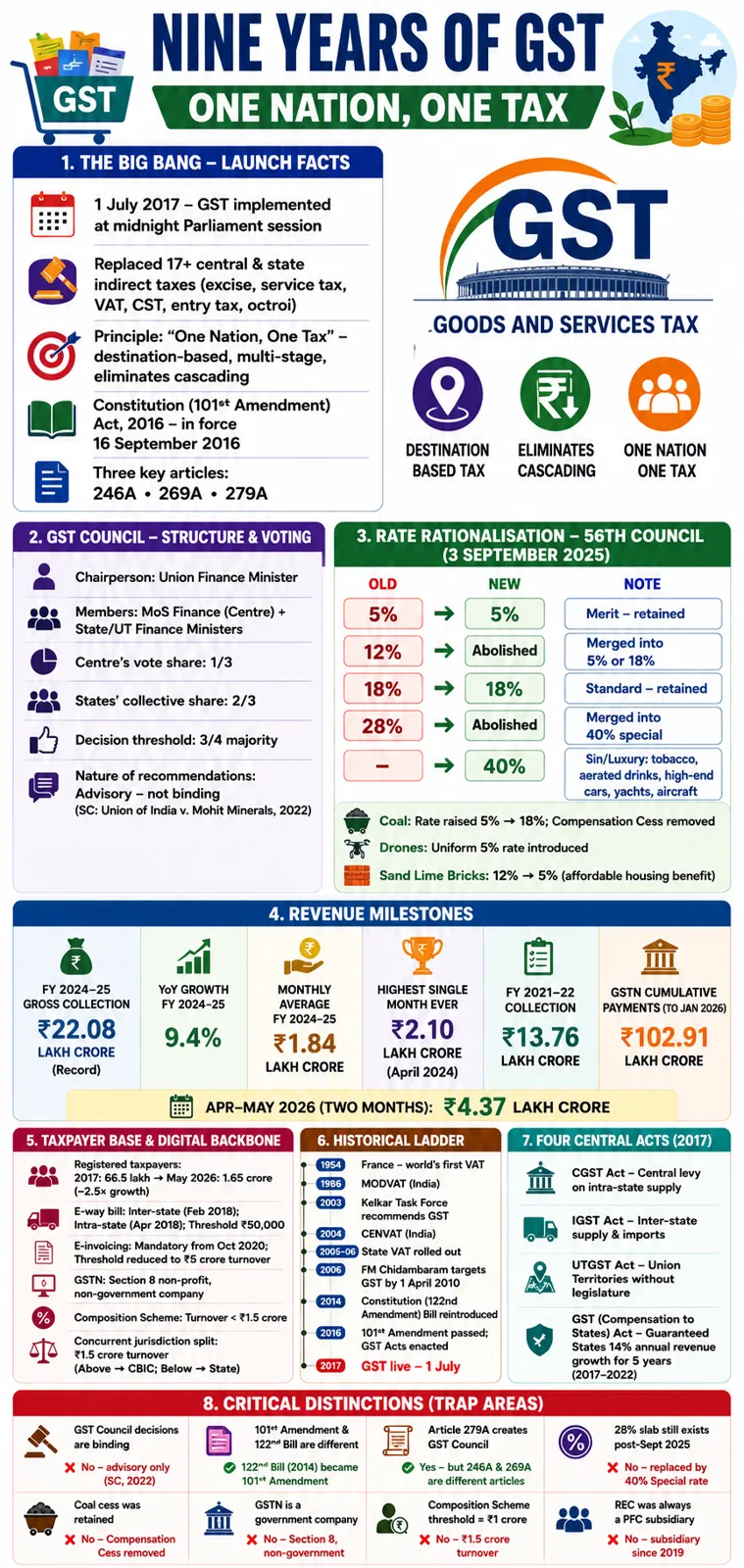
- GST (Goods and Services Tax) is a unified, destination-based, multi-stage indirect tax that replaced a fragmented web of central and state levies (excise duty, service tax, VAT, CST, entry tax, octroi, etc.) on 1 July 2017 — completing India's biggest post-Independence tax reform. [1]
- Operates on the principle of "One Nation, One Tax", creating a common national market and eliminating the cascading ("tax on tax") effect. [1]
- UPSC relevance: tested across GS-III (taxation, fiscal federalism), GS-II (Centre-State relations), and Essay; repeated in Prelims for factual hooks (rates, slabs, council, enabling article).
- The 9th GST Day (1 July 2026) coincides with landmark Next-Generation reforms — the most structural overhaul since 2017. [1]
2. Why in the News
- 56th GST Council Meeting (3 September 2025, New Delhi): Approved a historic rate rationalization — compressed the four-tier slab structure (5%-12%-18%-28%) into a simpler two-slab system (5% and 18%) plus a 40% special rate for sin/luxury goods; changes effective 22 September 2025 for most goods and services. [3]
- Record Annual Collection in FY 2024-25: Gross GST collection hit ₹22.08 lakh crore — highest ever — with 9.4% YoY growth and average monthly collection of ₹1.84 lakh crore. [2]
- April 2024: Single-month collection record of ₹2.10 lakh crore — highest ever monthly figure at that time. [4]
- PIB Backgrounder dated 30 June 2026 released ahead of GST Day 2026, framing nine years of achievements and ongoing Next-Gen reforms. [1]
3. Background & Evolution
Pre-GST Context:
- India operated 17+ central and state indirect taxes with cascading effects, multiple registrations, and inter-state barriers (Central Sales Tax, Octroi).
- Kelkar Task Force (2003): First recommended a comprehensive GST for India.
- 2006: Finance Minister P. Chidambaram set 1 April 2010 as target date — missed due to political resistance.
- Constitution (101st Amendment) Act, 2016: The enabling legislation — inserted Article 246A (concurrent power to levy GST), Article 269A (IGST on inter-state trade), and Article 279A (GST Council); brought into force 16 September 2016.
Key Milestones (Chronological):
| Year | Milestone |
|---|---|
| 2003 | Kelkar Task Force recommends GST |
| 2006 | FM Chidambaram announces 2010 target |
| 2014 | Constitution (122nd Amendment) Bill reintroduced by NDA |
| Aug 2016 | Constitution (101st Amendment) Act, 2016 passed |
| Sep 2016 | GST Council constituted; GSTN operationalised |
| 1 Jul 2017 | GST launched at midnight Parliament session |
| 2017-18 | Teething troubles — rates revised for 200+ items in first year |
| 2018-19 | E-way bill system introduced (Feb 2018 inter-state; Apr 2018 intra-state) |
| Oct 2020 | E-invoicing made mandatory for B2B transactions (₹500 cr+ turnover initially) |
| 2021-22 | Collections crossed ₹13.76 lakh crore |
| 2023-24 | Monthly collections consistently above ₹1.5 lakh crore |
| Apr 2024 | Single-month record: ₹2.10 lakh crore [4] |
| 2024-25 | Annual record: ₹22.08 lakh crore [2] |
| Sep 2025 | 56th GST Council: Rate rationalization — 2-slab + 40% structure approved [3] |
| 2025-26 | Total collections: ~₹22.27 lakh crore [1] |
| Apr-May 2026 | Collections: ₹4.37 lakh crore (two months) [1] |
4. Core Static Facts
Constitutional & Legal Framework:
- Enabling Article: Article 246A (inserted by 101st Amendment) — concurrent legislative power on GST to Parliament and State Legislatures
- IGST: Article 269A — Parliament levies Integrated GST on inter-state supply; proceeds apportioned between Centre and States
- GST Council: Article 279A — constitutional body for recommendations on rates, exemptions, thresholds
- Central Acts: CGST Act 2017, IGST Act 2017, UTGST Act 2017, GST (Compensation to States) Act 2017
GST Council Composition:
- Chairperson: Union Finance Minister
- Members: Union Minister of State for Finance + Finance Ministers of all States/UTs with legislatures
- Voting: Centre holds 1/3 votes; States collectively hold 2/3 votes; decisions by 3/4 majority
Rate Structure (Post-56th Council, effective 22 Sep 2025):
| Slab | Coverage |
|---|---|
| 0% (Exempt) | Essential food grains, fresh vegetables, milk, etc. |
| 5% (Merit Rate) | Basic necessities — staple packaged foods, medicines, drones [3] |
| 18% (Standard Rate) | Most goods and services |
| 40% (Special Rate) | Sin/luxury: pan masala, tobacco, aerated drinks, high-end cars, yachts, private aircraft [1] |
(Previous 12% and 28% slabs abolished under Next-Gen reform)
Key Numbers:
- GST registered taxpayers: 66.5 lakh (2017) → 1.65 crore (May 2026) — ~2.5x growth [1]
- FY 2024-25 gross collection: ₹22.08 lakh crore (9.4% YoY) [2]
- FY 2025-26 gross collection: ~₹22.27 lakh crore [1]
- Highest ever monthly collection: ₹2.10 lakh crore (April 2024) [4]
- GSTN payments processed (cumulative to Jan 2026): ₹102.91 lakh crore [2]
- Five-year revenue growth: ₹13.76 lakh crore (2021-22) → ₹22.27 lakh crore (2025-26) [1]
Implementing Institutions:
- Ministry of Finance (Dept. of Revenue) — nodal ministry
- GSTN (GST Network): Non-profit, non-government company (Section 8) — technology backbone
- CBIC (Central Board of Indirect Taxes and Customs): Administrative enforcement
Key Digital Systems:
- GST Portal (gst.gov.in): Registration, filing, payment
- E-way Bill System: Mandatory for goods movement > ₹50,000 value
- E-invoicing (IRP): Invoice Registration Portal for real-time B2B invoice data capture
- GSTR-1, GSTR-3B, GSTR-9: Key return forms
5. Multi-Dimensional Analysis
Economic
- GST expanded the formal tax base — registered taxpayers grew from ~66.5 lakh to 1.65 crore, integrating the informal sector. [1]
- Annual collections grew from ~₹7.19 lakh crore (2017-18, partial year) to ₹22.27 lakh crore (2025-26), reflecting structural formalization and buoyancy. [1][2]
- Elimination of cascading tax reduced the embedded cost of goods, theoretically lowering prices; empirical effects remain contested in literature.
- Rate rationalization (removing 12% slab) simplifies compliance cost for MSMEs — a key lobbying priority of small trade. [1]
- Coal: GST Compensation Cess removed; rate raised 5% → 18% under 56th Council — significant for power sector input costs. [3]
Legal / Constitutional
- The Constitution (101st Amendment) Act, 2016 is India's most consequential fiscal federalism amendment — it curtailed exclusive State power over sales tax (Entry 54, State List) and Centre's exclusive power over excise (Entry 84, Union List).
- Article 279A(10): Every decision of the GST Council to be by a majority of not less than 3/4 of weighted votes — giving states collective veto power.
- GST Compensation Clause (2017-22): States guaranteed 14% annual revenue growth for 5 years; compensation cess extended but wound down after 2022 amid Centre-State tensions.
- Supreme Court (Union of India v. Mohit Minerals, 2022): Held that GST Council recommendations are not binding on Centre or States — clarified the advisory (not mandatory) nature of Council decisions.
Administrative / Federalism
- GST is administered concurrently by Centre (CBIC) and States (State GST departments) — dual control: taxpayers with turnover > ₹1.5 crore under Centre's jurisdiction (for CGST); below ₹1.5 crore under State jurisdiction (for SGST), with cross-empowerment.
- IGST mechanism for inter-state transactions ensures seamless Input Tax Credit (ITC) flow across state borders — the key innovation resolving the pre-GST CST problem.
- Centre-State revenue sharing (SGST/CGST): Revenue from intra-state transactions split equally (50:50) between Centre and State.
- State compensation disputes (2020-22) exposed Centre-State trust deficit; States demanded direct borrowing authority and cess extension. [5]
Technological / Scientific
- E-invoicing (mandatory from Oct 2020, threshold progressively lowered to ₹5 crore): Enables real-time capture of B2B invoice data at IRP — reduces manual reporting and GST fraud. [2]
- GSTN processed ₹102.91 lakh crore in cumulative payments by Jan 2026 — one of India's largest civilian IT systems. [2]
- AI/analytics deployment by GSTN and CBIC for fake ITC detection; BIFA (Business Intelligence and Fraud Analytics) tools operational.
- Drones: Unified 5% GST rate approved at 56th Council — removes differential taxation and supports PLI-linked drone manufacturing. [3]
Social / Equity
- Zero-rated essentials (food grains, vegetables, milk) protect the poor from the regressive nature of indirect taxes.
- Rate reduction under Next-Gen reforms specifically targeted MSMEs, artisans, farmers, exporters — labour-intensive sectors. [1]
- Composition Scheme (small taxpayers with turnover < ₹1.5 crore): Simplified quarterly returns and fixed-rate levy — reduces compliance burden for micro-enterprises.
- Sand lime bricks: Rate cut 12% → 5% at 56th Council — benefits affordable housing / small construction. [3]
Historical
- India's GST is modeled on Canada's dual GST (Federal + Provincial) — not the single EU-style VAT, given India's federal complexity.
- Predecessors: MODVAT (1986) → CENVAT (2004) (credit mechanisms for excise) → State VAT (2005-06) — sequential steps toward integrated taxation before GST.
- France (1954) introduced the world's first VAT; India adopted GST 63 years later as a more evolved dual model.
6. Recent Developments (Last 12–18 Months)
- Sep 3, 2025 — 56th GST Council Meeting (New Delhi): Approved most sweeping rate rationalization since 2017 — collapsed 4-slab structure (5-12-18-28%) to 2 slabs (5%-18%) + 40% sin rate. [3]
- Sep 22, 2025: Rate changes on goods and services (excluding cigarettes, zarda, unmanufactured tobacco, beedi) came into effect. [3]
- Coal sector: Compensation Cess removed; GST rate raised 5% → 18% — significant shift affecting power sector. [3]
- Drones: Uniform 5% GST mandated — supports emerging aerospace/defense manufacturing. [3]
- FY 2024-25 Annual Record: ₹22.08 lakh crore gross collection; 9.4% growth; average monthly ₹1.84 lakh crore. [2]
- April 2024: All-time monthly high of ₹2.10 lakh crore recorded. [4]
- May 2024: ₹1.73 lakh crore (10% YoY growth). [4]
- March 2024: ₹1.78 lakh crore — second highest monthly collection at the time (11.5% YoY). [5]
- FY 2025-26 (cumulative): ~₹22.27 lakh crore; April-May 2026 alone: ₹4.37 lakh crore. [1]
- Taxpayer base: Reached 1.65 crore by May 2026 — up from 66.5 lakh at inception. [1]
- PIB Backgrounder (30 June 2026): Government released comprehensive Nine Years of GST assessment ahead of GST Day 2026, framing Next-Gen reforms as a continuation of One Nation One Tax vision. [1]
7. Prelims Hooks (High-Density Factual Bullets)
- GST was launched on 1 July 2017 at a special midnight Parliament session — the only other such midnight session was India's Independence on 15 August 1947. [1]
- The enabling constitutional provision is Article 246A, inserted by the Constitution (101st Amendment) Act, 2016. [1]
- GST Council is established under Article 279A; Union Finance Minister is its Chairperson. [1]
- GST Council decisions require a 3/4 weighted majority — Centre holds 1/3 votes, all States together hold 2/3 votes. [1]
- GSTN (GST Network) is structured as a Section 8 (non-profit) company — technology backbone of GST. [2]
- Highest-ever monthly GST collection: ₹2.10 lakh crore in April 2024. [4]
- Highest-ever annual GST collection: ₹22.08 lakh crore in FY 2024-25 (9.4% YoY growth). [2]
- 56th GST Council (3 Sep 2025): Approved two-slab (5% & 18%) + 40% sin rate structure — effective 22 Sep 2025. [3]
- Under the new rate structure, the 12% and 28% slabs are abolished; replaced by 5%, 18%, and 40%. [3]
- 40% special rate applies to: pan masala, tobacco products, aerated drinks, high-end cars, yachts, private aircraft. [1]
- Coal GST: Compensation Cess removed; GST rate hiked from 5% to 18% at 56th Council. [3]
- Drones: Uniform 5% GST rate approved at 56th Council (previously differential). [3]
- GST registered taxpayers grew from 66.5 lakh (2017) to 1.65 crore (May 2026) — ~2.48x increase. [1]
- E-invoicing under GST: Invoice Registration Portal (IRP) — mandatory for B2B transactions; captures invoice data in real time to prevent fake ITC claims. [2]
- Supreme Court in Mohit Minerals (2022): GST Council recommendations are not binding on Centre or States — advisory in nature. [3]
8. Mains Relevance
GS Paper Mapping:
| Paper | Specific Syllabus Heading |
|---|---|
| GS-III | Indian Economy — Taxation; Effects of liberalization on the economy; Government Budgeting |
| GS-II | Centre-State Relations; Federalism; Constitutional provisions |
| GS-II | Government policies and interventions for development |
Plausible Mains Question Stems:
- "Nine years after its implementation, evaluate the achievements and remaining challenges of GST as a tool for cooperative federalism in India." (GS-III / GS-II, 15 marks)
- "The Next-Generation GST reforms of 2025, particularly the shift to a two-slab structure, represent a balance between revenue adequacy and equity. Critically examine." (GS-III, 15 marks)
- "The GST Council is a unique institution in India's cooperative federalism. Discuss its constitutional basis, decision-making mechanism, and the tensions revealed during the COVID-19 compensation cess controversy." (GS-II, 10 marks)
9. Related Topics to Study Next
| Topic | Connection |
|---|---|
| Constitutional (101st Amendment) Act, 2016 | Direct enabling law for GST; Articles 246A, 269A, 279A must be known precisely |
| Fiscal Federalism in India | GST is the most consequential Centre-State fiscal arrangement since 1950; links to Finance Commission, devolution |
| Direct Tax Code / Income Tax Reform | GST reformed indirect taxes; direct tax modernization is the counterpart structural reform aspirants must compare |
| E-way Bill & E-invoicing Systems | Technology backbone of GST compliance; links to Digital India, anti-evasion policy |
| GST Compensation Cess | Post-2022 controversy; Centre-State fiscal relations; used to fund state revenue shortfalls during COVID |
| Ease of Doing Business (EoDB) Reforms | GST's compliance simplification is a key EoDB driver; World Bank rankings context |
| MSME Policy & Formalization | Composition Scheme under GST; how GST integration affected informal sector |
| Public Finance & Government Budgeting | Revenue buoyancy, tax-GDP ratio, impact of GST on states' own tax revenue |
10. Common Errors / Trap Areas
-
Wrong Amendment Number: GST is enabled by the 101st Amendment, not 122nd — the 122nd Amendment Bill was the draft introduced in 2014; it was enacted as the 101st Amendment Act 2016. Many aspirants confuse the Bill number with the Act number.
-
GSTN ownership confusion: GSTN is NOT a government department or PSU — it is a Section 8 (non-profit) private company (though government holds majority stake post-2018 restructuring). Do not confuse with a ministry or statutory body.
-
GST Council vote shares: Aspirants often flip Centre and States — Centre = 1/3 votes; States collectively = 2/3 votes. The 3/4 majority requirement means Centre alone cannot pass anything; States must be on board.
-
Rate structure confusion (pre vs. post 2025): The 28% slab and 12% slab are abolished under Next-Gen reforms (effective Sep 2025). Questions set in 2025-26 may test the new structure (5%, 18%, 40%), not the old four-tier (5%, 12%, 18%, 28%). Know both periods.
-
"Mohit Minerals" judgment mis-cited: Some aspirants incorrectly state the SC held GST Council decisions are binding — the opposite is true. The 2022 ruling clarified they are recommendatory, restoring concurrent legislative sovereignty of Parliament and State Legislatures.
Sources
- 1Nine Years of GST: Simplifying Taxation, Strengthening India — PIB Backgrounder, 30 June 2026pib.gov.in · tier 1
- 2Record Gross GST Collection in 2024-25 — PIB Press Notepib.gov.in · tier 1
- 3Recommendations of the 56th Meeting of the GST Council held at New Delhi — PIB Press Releasepib.gov.in · tier 1
- 4GST Revenue Collection for April 2024 — Highest Ever at ₹2.10 Lakh Crore — PIB Press Releasepib.gov.in · tier 1
- 5Ministry of Finance Year Ender 2024: Department of Revenue — PIB Press Releasepib.gov.in · tier 1