Thermal signatures of three decades of solar storms at Earth reveal new clues for space weather forecasting
New · District CollectorCan you hold the district for 72 hours?Floods, a heatwave, an outbreak, a grievance queue. Take the decisions, see the consequences.Play →In this note
1. At a Glance
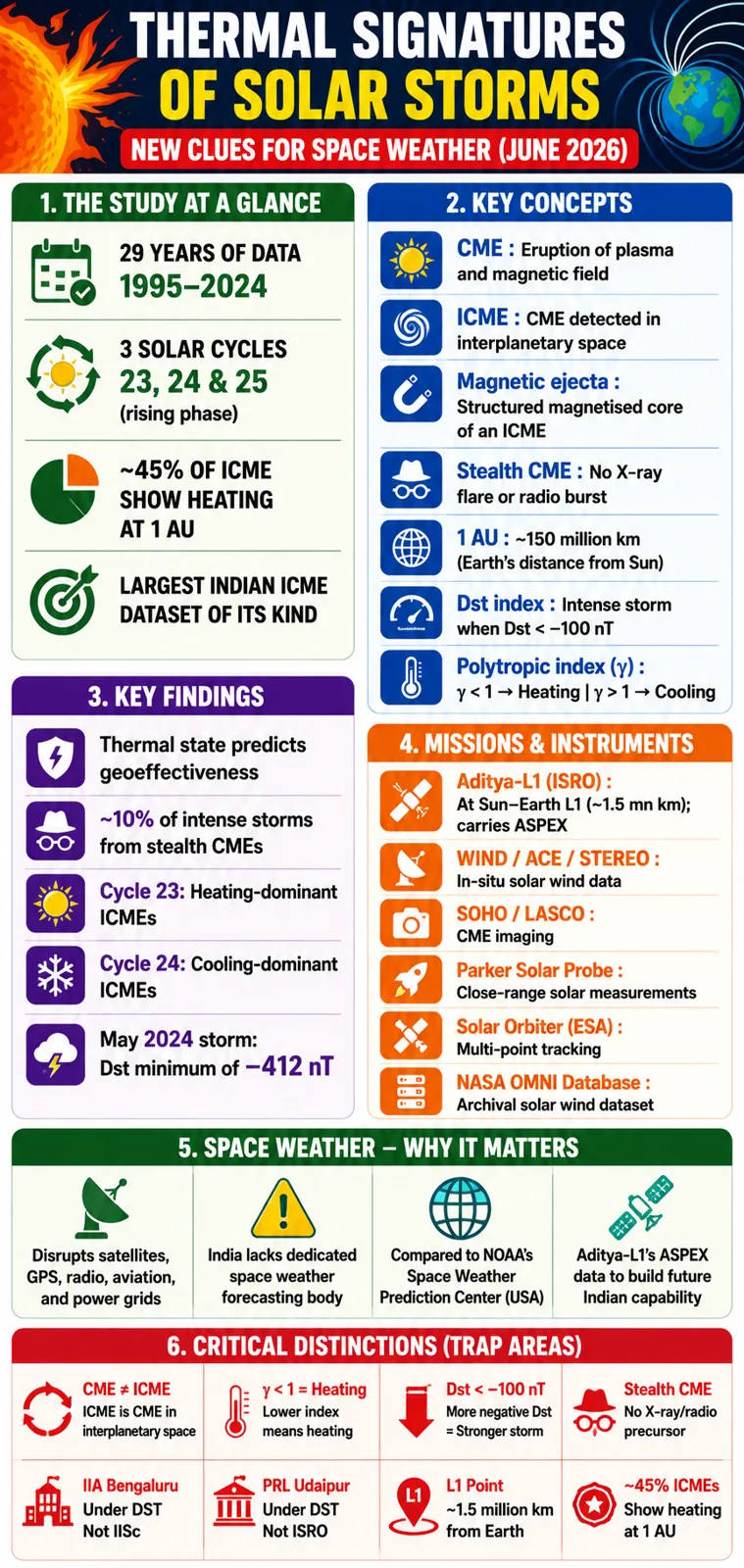
- Indian astrophysicists from the Indian Institute of Astrophysics (IIA), Bengaluru (an autonomous institute under Department of Science & Technology, GoI) have published a landmark study on how Interplanetary Coronal Mass Ejections (ICMEs) evolve thermally during their Sun-to-Earth transit and how this thermal state determines their capacity to generate geomagnetic storms. [1]
- The study spans 29 years of data (1995–2024) across three solar cycles (23, 24, and rising phase of 25), making it among the longest-baseline Indian astrophysics datasets of its kind. [1]
- Key finding: ~45% of magnetic ejecta show heating signatures at 1 AU (Earth's orbital distance); thermal state (quantified via polytropic index) is a meaningful predictor of a storm's geoeffectiveness — its capacity to disrupt satellites, GPS, radio communications, aviation, and power grids. [1]
- UPSC relevance: Intersects GS-III (science & technology, space, disaster management) and current affairs on India's space weather research capacity, especially post Aditya-L1 mission. [2][3]
2. Why in the News
- June 30, 2026: PIB press release announced findings by Soumyaranjan Khuntia (doctoral scholar, IIA) and Associate Professor Wageesh Mishra (IIA), published in Monthly Notices of the Royal Astronomical Society (MNRAS). [1]
- Context: This follows India's Aditya-L1 mission (launched September 2023, stationed at Sun-Earth L1 Lagrangian point) that now provides live solar wind data, giving Indian research a direct observational stake in space weather forecasting. [2]
- Related 2023–24 events: A stealth CME on March 19, 2023 caused an intense geomagnetic storm despite showing no standard solar warning indicators (no X-ray flares, no radio bursts), highlighting the critical gap in forecasting that thermal-signature research addresses. [3]
- May 2024: The strongest geomagnetic storm of Solar Cycle 25 struck Earth (Dst minimum: −412 nT), renewing global urgency around space weather preparedness. [4]
3. Background & Evolution
Origin and Rationale
- Coronal Mass Ejections (CMEs) — massive blasts of magnetized plasma from the Sun's outer atmosphere (corona) — were first systematically observed in the 1970s via coronagraph instruments. Their interplanetary counterparts, ICMEs, were identified by distinctive in-situ plasma signatures at 1 AU.
- Early research treated ICMEs as adiabatically expanding (simply cooling as they expand). The new paradigm — showing ICMEs can be thermodynamically active (heating in transit) — is a significant departure.
Key Milestones
| Year | Milestone |
|---|---|
| 1995 | NASA's WIND spacecraft begins in-situ L1 solar wind measurements; forms the backbone of the 29-year OMNI dataset |
| 1996 | SOHO (LASCO coronagraph) launched; first systematic CME imaging from space |
| 2006 | STEREO-A & B launched; enables stereoscopic 3D reconstruction of CME propagation |
| 2020 | IIG (DST) publishes MNRAS paper: ICMEs flatten and deform into quasi-2D planar structures during solar wind transit — first observational verification [5] |
| Sep 2023 | India's Aditya-L1 launched to L1 point; carries ASPEX instrument for in-situ solar wind particle measurements [2] |
| 2024 | Parker Solar Probe data incorporated into Indian research workflows [5] |
| Jun 2026 | IIA (DST) publishes 29-year thermal-state analysis of ICMEs in MNRAS [1] |
Predecessor Research by Indian Institutions
- IIG (DST), Dr. Zubair Shaikh: Analysed 420 ICMEs (1998–2017); showed ICMEs flatten into planar structures — affects arrival-time and geomagnetic disturbance predictions. Published in MNRAS (2020) and ApJ (2022). [5]
- IIA (DST), Dr. Wageesh Mishra: Multi-point STEREO/SOHO/WIND study of 2011 ICMEs; showed arrival-time prediction fails without ambient solar wind data. Published in MNRAS. [2]
- IIA (DST), P. Vemareddy: Stealth CME of March 2023 study; found ~10% of intense geomagnetic storms originate from inconspicuous solar eruptions. [3]
4. Core Static Facts
Key Definitions
- CME (Coronal Mass Ejection): Blast of magnetized plasma from the Sun's corona; can carry up to 10¹³ kg of material at speeds of 250–3,000 km/s.
- ICME (Interplanetary CME): A CME as detected in interplanetary space (between Sun and Earth); identified by depressed proton temperature, smooth magnetic field rotation, and low plasma-β.
- Magnetic Ejecta (ME) / Magnetic Cloud: The structured magnetized core of an ICME, exhibiting a smooth, rotating magnetic field.
- Sheath Region: Compressed plasma ahead of the ICME ejecta, between the CME-driven shock and the leading edge of the ejecta.
- Geomagnetic Storm: Disturbance of Earth's magnetosphere caused by enhanced solar wind; measured by the Dst (Disturbance Storm Time) index (nT). Intense: Dst < −100 nT.
- Polytropic Index (γ): Ratio describing how pressure varies with density in a gas. In ICME research, γ < 1 indicates heating; γ > 1 indicates cooling/expansion. Key diagnostic of ICME thermal state. [1]
- Geoeffectiveness: An ICME's capacity to cause geomagnetic storms; dependent on southward magnetic field (Bz), plasma density, speed, and — per this study — thermal state. [1]
- L1 Lagrangian Point: Gravitational balance point between Sun and Earth (~1.5 million km from Earth); preferred location for space weather monitoring satellites (WIND, ACE, SOHO, Aditya-L1).
- Stealth CME: CME with no detectable precursor signatures on the Sun (no flares, no radio bursts); hardest to forecast. [3]
- Plasma-β: Ratio of plasma pressure to magnetic pressure; low β in ICMEs indicates magnetically dominated structures.
- 1 AU (Astronomical Unit): ~150 million km; Earth's mean distance from Sun.
Implementing Body
- Research Institution: Indian Institute of Astrophysics (IIA), Bengaluru [1]
- Funding/Parent Body: Department of Science & Technology (DST), Ministry of Science & Technology, Government of India [1][2]
- Collaborating Institutions (this study): IIA (Bengaluru), C.U. Shah University (Gujarat), Physical Research Laboratory (PRL, Udaipur), Max Planck Institute for Solar System Research (Germany) [2]
- Related Mission: Aditya-L1, implemented by ISRO [2]
Key Numbers
| Parameter | Value |
|---|---|
| Dataset timespan | 29 years (1995–2024) |
| Solar cycles covered | 23, 24, rising phase of 25 |
| Magnetic ejecta showing heating at 1 AU | ~45% |
| ICMEs analysed (IIG study) | 420 (1998–2017) |
| Stealth CME-caused intense storms | ~10% of total |
| May 2024 storm Dst minimum | −412 nT |
| Aditya-L1 launch date | September 2023 |
| Aditya-L1 orbital location | Sun-Earth L1 point |
| Primary data repository | NASA OMNI database (CDAWeb) |
Data Sources Used
- NASA's OMNI database (CDAWeb), WIND spacecraft, ACE, STEREO-A/B, SOHO/LASCO, Solar Orbiter, Parker Solar Probe, ASPEX/Aditya-L1 [1][2][3][5]
5. Multi-Dimensional Analysis
Scientific / Technological
- Thermal state paradigm shift: ICMEs were long modelled as adiabatically cooling; this study establishes they are thermodynamically active — energy transfer processes operate even in transit, with ~45% showing net heating at 1 AU. [1]
- Polytropic index as forecasting tool: The study proposes using γ (polytropic index) as a thermal precursor — combined with magnetic field and plasma data, it can refine predictions of a storm's geoeffectiveness before arrival. [1]
- Solar-cycle variation: Heating-dominant states were more prevalent in Solar Cycle 23 (more active); cooling-dominant states dominated Solar Cycle 24 (the quietest cycle in a century). This cycle-dependence has implications for current Cycle 25 predictions. [1]
- Aditya-L1 synergy: India now generates primary solar wind data via ASPEX instrument, enabling near-real-time Indian input into global space weather forecasting chains. [2]
Geopolitical / Strategic
- Critical infrastructure vulnerability: Intense geomagnetic storms can destroy high-voltage transformers (1989 Quebec blackout), disrupt HF radio used by aviation on polar routes, corrupt GPS signals, and accelerate satellite orbital decay — all with strategic and economic consequences for India's growing space-based infrastructure. [1]
- Space weather diplomacy: India's investment in L1-point monitoring (Aditya-L1) positions it as a data-sharing partner in international space weather networks (ISWI, NOAA/SWPC collaborations), raising its scientific diplomacy profile. [2]
- Aditya-L1 data sovereignty: Domestic generation of solar wind data reduces India's dependence on NASA/ESA spacecraft for early warning — strategically important for defence communications and satellite operations. [2]
Environmental / Disaster Risk
- Power grid disruption: Geomagnetically induced currents (GICs) from intense storms can saturate transformers in high-latitude power grids; India's expanding grid at mid-latitudes is increasingly exposed as storm intensities in Cycle 25 rise. [1]
- Aviation safety: Polar and high-latitude routes face HF radio blackouts and increased radiation exposure during solar particle events — understanding geoeffectiveness improves route planning lead times. [1]
- Satellite operations: GPS, communication, and remote sensing satellites (RISAT, CARTOSAT, NavIC) face surface charging, increased drag, and sensor disruption during intense storms. [1]
Administrative / Governance
- Space weather policy gap: India lacks a dedicated national space weather policy or forecast centre equivalent to NOAA's Space Weather Prediction Center (SWPC) or ESA's Space Weather Service Network (SSWEN). This research underscores the need. [1][2]
- Inter-ministry coordination requirement: Space weather impacts span Ministry of Communications (HF radio), Civil Aviation, Power Ministry (grid protection), Ministry of Defence (GPS/communications), and DST/ISRO — requiring a unified early-warning protocol. [1]
- Autonomous institute model: Both IIA and IIG function as DST-funded autonomous institutes — research is frontier-grade but lacks a direct operational mandate; translating research into real-time forecasting services remains a gap. [2][5]
Economic
- Satellite economy at risk: India's space economy (target: $44 billion by 2033 per IN-SPACe) depends on uninterrupted satellite operations; even a single Carrington-class event could cause trillions in global satellite asset losses. [1]
- NavIC reliability: India's indigenous GPS system (NavIC) is particularly vulnerable to ionospheric disturbances from geomagnetic storms; improved forecasting directly protects navigation-dependent sectors (logistics, agriculture, defence). [1]
6. Recent Developments (Last 12–18 Months)
- June 30, 2026: PIB announces IIA study (Khuntia & Mishra) published in MNRAS — 29-year thermal-state analysis of ICMEs across Solar Cycles 23–25. [1]
- May 2024: Strongest geomagnetic storm of Solar Cycle 25 (Dst: −412 nT) triggered by NOAA AR 13664 — one of the largest active regions in recent decades. Aditya-L1's ASPEX instrument recorded in-situ particle energisation during this event. [4]
- 2025: Aditya-L1 ASPEX data used in Indian research publications, establishing India's in-house observational capability at L1. [4]
- 2023 (ongoing): IIA's stealth CME study (Vemareddy et al.) published — March 19, 2023 event showed how subtle CMEs with no precursors cause intense storms (Dst well below −100 nT); ~10% of intense storms fall in this category. [3]
- 2022: IIG's ApJ paper (Shaikh) confirmed planar ICME morphology affects arrival-time and intensity prediction models; flagged direct relevance to Aditya-L1 mission planning. [5]
7. Prelims Hooks (High-Density Factual Bullets)
- IIA (Indian Institute of Astrophysics), Bengaluru, is an autonomous institute under Department of Science & Technology (DST), Ministry of Science & Technology. [1]
- The 29-year ICME thermal study (1995–2024) covers Solar Cycles 23, 24, and the rising phase of Solar Cycle 25. [1]
- Data sourced from NASA's OMNI database accessed via the CDAWeb repository, using measurements from L1-point spacecraft. [1]
- The study was published in Monthly Notices of the Royal Astronomical Society (MNRAS). [1]
- Approximately 45% of magnetic ejecta show heating signatures at 1 AU, particularly near solar maximum. [1]
- The key thermal diagnostic used is the polytropic index (γ): γ < 1 indicates heating; γ > 1 indicates cooling during ICME expansion. [1]
- Heating-dominant ICMEs are the most geoeffective — characterised by strong magnetic fields, low plasma-β, compressed sheath, and enhanced expansion speeds. [1]
- ICMEs heating states were more common in Solar Cycle 23; cooling states dominated the quieter Solar Cycle 24. [1]
- Aditya-L1 was launched in September 2023 and is stationed at the Sun-Earth L1 Lagrangian point (~1.5 million km from Earth). Implementing agency: ISRO. [2]
- A Stealth CME is defined as a CME showing no X-ray flares or radio burst precursors on the solar disc; ~10% of intense geomagnetic storms originate from stealth CMEs. [3]
- IIG (Indian Institute of Geomagnetism) — also under DST — showed that ICMEs flatten into quasi-2D planar structures during solar wind transit (MNRAS, 2020). [5]
- The Dst (Disturbance Storm Time) index measures geomagnetic storm intensity; intense storms have Dst < −100 nT. [3]
- The May 2024 geomagnetic storm had a minimum Dst of −412 nT — the strongest in Solar Cycle 25. [4]
- The sheath region of an ICME (compressed plasma between shock and ejecta) plays a key role in geomagnetic storm intensity by compressing Earth's magnetosphere even before the magnetic cloud arrives. [1]
- Physical Research Laboratory (PRL), Udaipur and Max Planck Institute for Solar System Research (Germany) are collaborators in IIA's space weather research. [2]
8. Mains Relevance
GS Paper Mapping
| GS Paper | Specific Syllabus Heading |
|---|---|
| GS-III | Science & Technology — developments and their applications; Space technology; Disaster Management (natural hazards) |
| GS-III | Infrastructure: Energy sector (grid vulnerability to geomagnetic storms) |
| GS-II | International Organisations; India's S&T diplomacy and bilateral scientific cooperation |
Plausible Mains Question Stems
- "Interplanetary Coronal Mass Ejections (ICMEs) pose a growing threat to India's critical infrastructure. In light of recent Indian astrophysics research, examine the mechanisms by which solar storms impact satellite operations, power grids, and communication systems, and suggest measures to enhance India's space weather preparedness." (GS-III)
- "Discuss the significance of the polytropic index as a diagnostic tool in space weather forecasting. How does India's Aditya-L1 mission enhance the country's capacity to predict geomagnetic storms?" (GS-III)
- "Stealth CMEs and thermally active ICMEs expose fundamental limitations of current space weather forecasting models. Critically analyse how recent Indian scientific contributions address these gaps and what institutional mechanisms India needs to operationalise space weather warnings." (GS-III / GS-II)
9. Related Topics to Study Next
| Topic | Connection |
|---|---|
| Aditya-L1 Mission | India's primary solar observation and L1-point monitoring asset; direct operational link to space weather data. |
| Solar Cycles and Sunspot Activity | Solar cycles drive ICME frequency and intensity; Cycle 25 is expected to peak ~2025. |
| NavIC (Navigation with Indian Constellation) | India's GPS equivalent is vulnerable to ionospheric disturbances from geomagnetic storms. |
| Critical Information Infrastructure Protection (CIIP) | Space weather is an emerging threat vector for power grids, telecom, and satellite assets — relevant to cybersecurity and disaster policy. |
| Ionospheric Effects and HF Radio Blackouts | Geomagnetic storms cause ionospheric disruptions affecting aviation (polar routes) and defence HF communications. |
| Disaster Management Act, 2005 & NDMA | Policy framework for natural (and technological) disaster preparedness — space weather is an emerging category. |
| India's Space Economy & IN-SPACe | Space asset vulnerability to solar storms is a commercial risk dimension for India's growing private space sector. |
| International Space Weather Initiative (ISWI) | UN-supported global coordination body for space weather monitoring; India's participation context. |
10. Common Errors / Trap Areas
- IIA vs. IIG vs. ISRO confusion: The thermal-signature ICME study is by IIA (Bengaluru) under DST — not ISRO, not IIG. ISRO built and operates Aditya-L1; IIG (also DST) did the separate planar-ICME morphology study. These are three different institutions.
- CME ≠ ICME: A CME is the solar eruption; an ICME is its detected form in interplanetary space. Examiners sometimes phrase questions expecting aspirants to know this distinction precisely.
- Polytropic index direction: γ < 1 → heating (counter-intuitive; dense ICMEs gain heat in transit); γ > 1 → cooling. Do not invert this.
- L1 Lagrangian point location: L1 is ~1.5 million km from Earth (not from the Sun) toward the Sun — roughly 1% of the Sun-Earth distance. Aditya-L1 orbits around L1 in a halo orbit, not parked at a fixed point.
- Stealth CME statistic: ~10% of intense geomagnetic storms originate from stealth CMEs — not all, and aspirants should not conflate "stealth CME" with "CME that causes no storm." A stealth CME can cause an intense storm precisely because it is undetected in advance. [3]
Sources
- 1"Thermal signatures of three decades of solar storms at Earth reveal new clues for space weather forecasting" — ummid.com report based on PIB/IIA release, summarising MNRAS study by Khuntia & Mishra (IIA, Bengaluru)ummid.com · tier 1
- 2"Study probes how ejections from sun corona influence space weather predictions crucial for monitoring satellites" — DST, Government of Indiadst.gov.in · tier 1
- 3"Intense Geomagnetic Storm shows effect of subtle solar CMEs on space weather" — DST, Government of India (IIA/Vemareddy stealth CME study)dst.gov.in · tier 1
- 4"The Solar and Geomagnetic Storms in May 2024" / Aditya-L1 ASPEX instrument findings — referenced via PIB and search synthesispib.gov.in · tier 1
- 5"Solar transient events like ICMEs can make the prediction of space weather uncertain" — DST, Government of India (IIG/Shaikh planar ICME study)dst.gov.in · tier 1